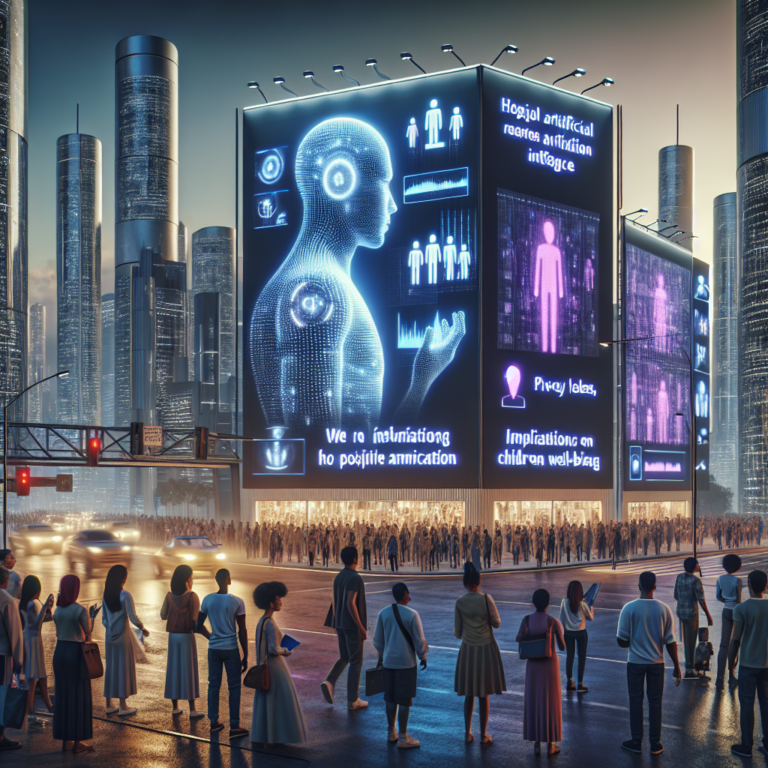
Create an Image Depicting an American Political Debate Between Human Politicians and Robots
Imagine a modern debate stage adorned with American flags, podiums, and an audience brimming with intrigue. On one side stand human politicians, their expressions solemn and engaged. On the other side, robots equipped with LED screens for faces, displaying various emotions. The atmosphere is tense but professional, encapsulating the theme of artificial intelligence in American politics. This scene captures the essence of a growing debate: Does artificial intelligence have any place in American politics?
The Rise of Artificial Intelligence in Modern Society
Artificial intelligence (AI) has made significant strides in recent years, infiltrating numerous domains from healthcare to finance. With its capacity to process vast amounts of data, detect patterns, and execute complex decisions, AI is often recognized for enhancing efficiency and accuracy. However, its introduction into the political arena raises a multitude of questions.
- Can AI improve the transparency and fairness of the political process?
- What are the ethical implications of AI-driven decisions in governance?
- How do we balance the potential benefits of AI with the need for human judgment?
Arguments For AI in Politics
Enhanced Data Processing and Analysis
Advocates for incorporating AI in politics argue that AI systems can analyze and interpret vast data sets more efficiently than humans. This allows for:
- Better Policy Decisions: AI can provide deeper insights into economic, social, and environmental trends, facilitating informed policy-making.
- Reduced Bias: AI algorithms, when designed and monitored correctly, can minimize human biases and promote fairer outcomes.
Transparency and Accountability
Proponents also highlight how AI can enhance transparency and accountability in governance:
- Public Access to Information: AI can analyze government data in real-time, making it more accessible to the public and promoting transparency.
- Accountability Mechanisms: AI systems can trace decision-making processes, identifying areas of inefficiency or corruption.
Arguments Against AI in Politics
Ethical and Moral Considerations
Despite its potential benefits, the introduction of AI in politics faces significant opposition. Critics emphasize the ethical and moral ramifications:
- Lack of Human Intuition: Critics argue that AI lacks the emotional intelligence and intuition necessary for nuanced political decisions.
- Ethical Dilemmas: Complex ethical decisions, such as matters of justice and equity, may be beyond the scope of AI’s capabilities.
Potential for Misuse
There are also concerns about the misuse of AI in politics:
- Manipulation and Bias: AI algorithms can be manipulated to reflect the biases of their developers, potentially skewing political outcomes.
- Privacy Concerns: The extensive data collection required for AI could lead to privacy violations and the misuse of personal information.
The Current State of AI in American Politics
The debate over AI’s role in American politics is far from settled. Currently, AI is primarily used in political campaigns for:
- **Analytics:** Campaigns analyze voter data to tailor messages and strategies.
- **Social Media Monitoring:** AI systems monitor social media platforms to gauge public opinion and respond to trends.
However, the notion of AI taking on more significant roles, such as policy-making or governance, remains controversial. While some politicians and technologists are optimistic about the potential of AI, others are wary of its limitations and risks.
The Future of AI in American Politics
The future of AI in American politics is uncertain but intriguing. Several factors will influence its trajectory:
- Technological Advances: As AI technology evolves, its capabilities and potential applications in politics will likely expand.
- Regulatory Frameworks: The development of robust regulatory frameworks will be crucial in ensuring the responsible use of AI.
- Public Opinion: The acceptance of AI in politics will depend largely on public perception and trust in these technologies.
Conclusion
The debate over AI’s place in American politics is a microcosm of broader societal questions about the role of technology in our lives. As we envision a scene where human politicians and robots face off on a debate stage, reflecting on AI’s potential and pitfalls becomes imperative. Whether AI will usher in a new era of political efficiency and fairness, or exacerbate existing issues, is a topic that will continue to shape discourse in the years to come. The ultimate goal should be to harness AI’s capabilities responsibly, ensuring that human values, ethics, and judgment remain at the forefront of political decision-making.
About the Author